City Hill PrecinctCity Village
The proposed City Hill Precinct is a radically sustainable urban village conceived for inclusive, mixed-use development. A public space, framed by landmark architecture, supports diversity and community interaction. It encourages cultural expression and embraces sustainable practices in both its creation and ongoing operation. Stewart Architecture led a multi-disciplinary team with Breathe, Tzannes, Yerrabingin, Arcadia Landscape, Finding Infinity, Neuron, Co-Motion, Jess Scully (Public Art) and ACT Consulting Engineers.
The proposed City Hill Precinct is a radically sustainable urban village conceived for inclusive, mixed-use development. A public space, framed by landmark architecture, supports diversity and community interaction. It encourages cultural expression and embraces sustainable practices in both its creation and ongoing operation. Stewart Architecture led a multi-disciplinary team with Breathe, Tzannes, Yerrabingin, Arcadia Landscape, Finding Infinity, Neuron, Co-Motion, Jess Scully (Public Art) and ACT Consulting Engineers.
Location
Canberra
State
ACT
Country
Ngunnawal
Client
Art Group
Expertise
Urban Design, Master Plan, Public, Commercial, Multi Residential
Year
2023
Collaborators
Breathe, Tzannes, Yerrabingin, Arcadia Landscape, Finding Infinity, Neuron, Co-Motion, Jess Scully (Public Art) and ACT Consulting Engineers
Renders
Narrative Graphics
1/4
Brief
A design-led bid for Block 1 Section 121 Vernon Circle, Canberra City. The City Renewal Authority led the project as part of the transformation of the City Hill precinct fronting London Circuit.
The site sits adjacent to Canberra’s City Hill, a well-known but sedentary Canberra landmark. While City Hill Park is underused and difficult to access on foot, it is an important component of Marion Mahony and Walter Burley Griffin’s design for Canberra and forms one point (the civic space) of the Parliamentary Triangle (the other two triangle points being Parliament House and the Defence Headquarters at Russell).
The site, bounded by Vernon Circle, Commonwealth Avenue, London Circuit, and Edinburgh Avenue, will soon have a light rail stop next to it. The brief asks designers to respond to the existing and emerging city grid, movement paths, and site topography, while making space for human activity at the site's core. It also directs the design team to focus on connections to Country, create urban comfort, maximise active edges and key corners, and prioritise pedestrians.
A design-led bid for Block 1 Section 121 Vernon Circle, Canberra City. The City Renewal Authority led the project as part of the transformation of the City Hill precinct fronting London Circuit.
The site sits adjacent to Canberra’s City Hill, a well-known but sedentary Canberra landmark. While City Hill Park is underused and difficult to access on foot, it is an important component of Marion Mahony and Walter Burley Griffin’s design for Canberra and forms one point (the civic space) of the Parliamentary Triangle (the other two triangle points being Parliament House and the Defence Headquarters at Russell).
The site, bounded by Vernon Circle, Commonwealth Avenue, London Circuit, and Edinburgh Avenue, will soon have a light rail stop next to it. The brief asks designers to respond to the existing and emerging city grid, movement paths, and site topography, while making space for human activity at the site's core. It also directs the design team to focus on connections to Country, create urban comfort, maximise active edges and key corners, and prioritise pedestrians.
Design
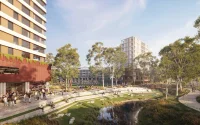
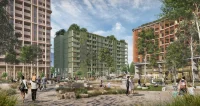
Like all good villages, the proposed City Hill Precinct is centered around a generous, well-defined public space.
We envision the precinct as a self-sufficient, zero-waste, zero-carbon community. Finding Infinity and Neuron led the environmental strategies, setting ambitious targets for water, waste, operational carbon, and embodied carbon. The team focused on resource efficiency, generation, and reuse throughout the precinct’s creation and ongoing operation.
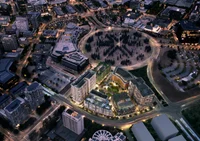
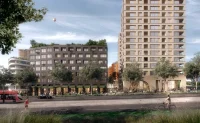
Arcadia Landscape designed an undulating native landscape at the precinct’s heart—a space to play and gather. Six buildings push to the site’s boundaries and surround the landscape. Unified by shared sustainability targets, the buildings form a single ecosystem. Stewart Architecture, Breathe, and Tzannes designed a variety of buildings to ensure visual and architectural diversity within the precinct. Each building addresses its individual interface with the city, with City Hill Park, the light rail on London Circuit, and the key connection to Commonwealth Avenue.
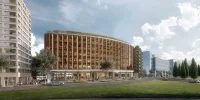
Five proposed buildings provide residential dwellings, with three offering affordable homes to buy or rent. Four buildings incorporate retail and commercial uses on their lower and ground floors, and one features a hotel. The sixth building features a cross-laminated timber office above a community space; its basement includes spaces for car charging and car sharing.
Yerrabingin led the embedding of community and cultural narratives throughout the site’s public spaces, gardens, and architecture. We proposed a program of workshops and events that frame and support the precinct as an accessible and active civic space. Social initiatives—such as laneway micro tenancies, rooftop gardens, a community laundry, workspaces, connecting in-between-building spaces, and play spaces—support a lively, connected, multi-generational, socially and culturally diverse community.
Like all good villages, the proposed City Hill Precinct is centered around a generous, well-defined public space.
We envision the precinct as a self-sufficient, zero-waste, zero-carbon community. Finding Infinity and Neuron led the environmental strategies, setting ambitious targets for water, waste, operational carbon, and embodied carbon. The team focused on resource efficiency, generation, and reuse throughout the precinct’s creation and ongoing operation.
Arcadia Landscape designed an undulating native landscape at the precinct’s heart—a space to play and gather. Six buildings push to the site’s boundaries and surround the landscape. Unified by shared sustainability targets, the buildings form a single ecosystem. Stewart Architecture, Breathe, and Tzannes designed a variety of buildings to ensure visual and architectural diversity within the precinct. Each building addresses its individual interface with the city, with City Hill Park, the light rail on London Circuit, and the key connection to Commonwealth Avenue.
Five proposed buildings provide residential dwellings, with three offering affordable homes to buy or rent. Four buildings incorporate retail and commercial uses on their lower and ground floors, and one features a hotel. The sixth building features a cross-laminated timber office above a community space; its basement includes spaces for car charging and car sharing.
Yerrabingin led the embedding of community and cultural narratives throughout the site’s public spaces, gardens, and architecture. We proposed a program of workshops and events that frame and support the precinct as an accessible and active civic space. Social initiatives—such as laneway micro tenancies, rooftop gardens, a community laundry, workspaces, connecting in-between-building spaces, and play spaces—support a lively, connected, multi-generational, socially and culturally diverse community.
Impact
The City Hill Precinct is a radically sustainable precinct designed as an inclusive, active, multigenerational neighbourhood. It delivers a missing piece of Marion Mahony and Walter Burley Griffin’s original plan for Canberra – a meaningful and inclusive civic space.
The precinct also delivers medium-density residential dwellings with a significant supply of affordable homes, well connected by public transport, in the heart of the city.
Our design was not the successful winning bid, which was awarded to the Capital Property Group with Bates Smart.
The City Hill Precinct is a radically sustainable precinct designed as an inclusive, active, multigenerational neighbourhood. It delivers a missing piece of Marion Mahony and Walter Burley Griffin’s original plan for Canberra – a meaningful and inclusive civic space.
The precinct also delivers medium-density residential dwellings with a significant supply of affordable homes, well connected by public transport, in the heart of the city.
Our design was not the successful winning bid, which was awarded to the Capital Property Group with Bates Smart.