St Paul's ChurchA Faithful Expansion
An expansion to the heritage listed St Paul’s Church in line with its original architectural design, and a series of urban design interventions to define circulation and gathering on the church grounds.
An expansion to the heritage listed St Paul’s Church in line with its original architectural design, and a series of urban design interventions to define circulation and gathering on the church grounds.
Location
Manuka
State
ACT
Country
Ngunnawal
Client
St Paul's Church
Expertise
Heritage, Urban Design, Cultural
Year
2003
Collaborators
Binutti Constructions, Young Consulting Engineers, Rogers & Jefferis Structural Engineers, Willis Brickworks
Photography
Will Neill




1/10
Brief
Our brief was to expand the church, in line with its current architecture, and to define and elevate the surrounding grounds.
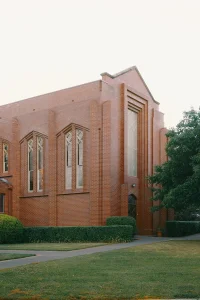
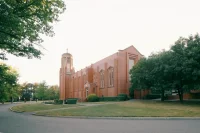
St Paul’s is an Anglican church, originally built in 1939, designed by Sydney architects John Burham Clamp and Son — an inter-war Gothic design with Art Deco influences, built in red brick. The church was based on an existing design by the same firm of the All-Saints Anglican Church in Moree, NSW. The church and its original landscape setting reflect the aesthetic principles that guided the National Capital’s development in the 1930s. The church sits on a prominent site at the corners of Canberra Avenue and Captain Cook Crescent in Manuka, in Canberra’s inner south.
The brief sits within a broader, ongoing master plan to create a small precinct for this church community that includes a modern home for the minister, a modern church hall, underground parking, and multistorey apartments to house the church’s members who would like to age amongst their spiritual fellowship.
Our brief was to expand the church, in line with its current architecture, and to define and elevate the surrounding grounds.
St Paul’s is an Anglican church, originally built in 1939, designed by Sydney architects John Burham Clamp and Son — an inter-war Gothic design with Art Deco influences, built in red brick. The church was based on an existing design by the same firm of the All-Saints Anglican Church in Moree, NSW. The church and its original landscape setting reflect the aesthetic principles that guided the National Capital’s development in the 1930s. The church sits on a prominent site at the corners of Canberra Avenue and Captain Cook Crescent in Manuka, in Canberra’s inner south.
The brief sits within a broader, ongoing master plan to create a small precinct for this church community that includes a modern home for the minister, a modern church hall, underground parking, and multistorey apartments to house the church’s members who would like to age amongst their spiritual fellowship.
Design
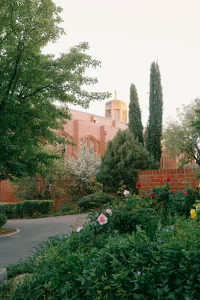
We added two bays to the church, replicating its existing architectural details and materials with extensive (pre-internet) research. Stained-glass windows were commissioned, ornate, hand-pressed red bricks were sourced from Willis Brickworks in Wagga, and the windows’ sandstone detailing was sourced from Sydney. The existing stained-glass window at the front of the church was carefully relocated. Inside, a new mezzanine was created for the choir, and the organ was repositioned, and timber floorboards were sourced to match the existing floors.
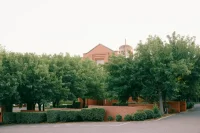
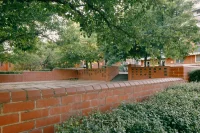
The grounds were designed to create a curtilage for the church community — a space to gather after service. The existing memorial courtyard was enclosed by a low, curved red brick wall – the curvilinear lines emulate the original Art Deco influence, contrasting the linear Gothic geometry of the church. Part of the wall serves as a memorial wall with plaques dedicated to the church’s congregants. Ornamental pear trees were planted for their summer shade and autumnal display.
Two red brick arbours define pedestrian pathways to the church grounds and into the courtyard; both act as a welcoming gesture that lowers the architectural scale of the site.
The church grounds’ car and walking pathways are defined by a designated parking area, a curved driveway, a roundabout, structured paths, and stairways to the street and the church hall.
We added two bays to the church, replicating its existing architectural details and materials with extensive (pre-internet) research. Stained-glass windows were commissioned, ornate, hand-pressed red bricks were sourced from Willis Brickworks in Wagga, and the windows’ sandstone detailing was sourced from Sydney. The existing stained-glass window at the front of the church was carefully relocated. Inside, a new mezzanine was created for the choir, and the organ was repositioned, and timber floorboards were sourced to match the existing floors.
The grounds were designed to create a curtilage for the church community — a space to gather after service. The existing memorial courtyard was enclosed by a low, curved red brick wall – the curvilinear lines emulate the original Art Deco influence, contrasting the linear Gothic geometry of the church. Part of the wall serves as a memorial wall with plaques dedicated to the church’s congregants. Ornamental pear trees were planted for their summer shade and autumnal display.
Two red brick arbours define pedestrian pathways to the church grounds and into the courtyard; both act as a welcoming gesture that lowers the architectural scale of the site.
The church grounds’ car and walking pathways are defined by a designated parking area, a curved driveway, a roundabout, structured paths, and stairways to the street and the church hall.
Impact
The church has been expanded to better serve its congregants; its existing design and materials have been carefully matched. The church grounds now have a logical flow for both cars and people, and the courtyard has been defined as an informal place to meet and chat.
The church has been expanded to better serve its congregants; its existing design and materials have been carefully matched. The church grounds now have a logical flow for both cars and people, and the courtyard has been defined as an informal place to meet and chat.